VOLKSWAGEN
STOP UYGHUR FORCED LABOUR
Volkswagen is STILL using parts made with Uyghur forced labour. Demand Volkswagen STOP sourcing from the Uyghur Region.
Demand Volkswagen STOP profiting from exploitation
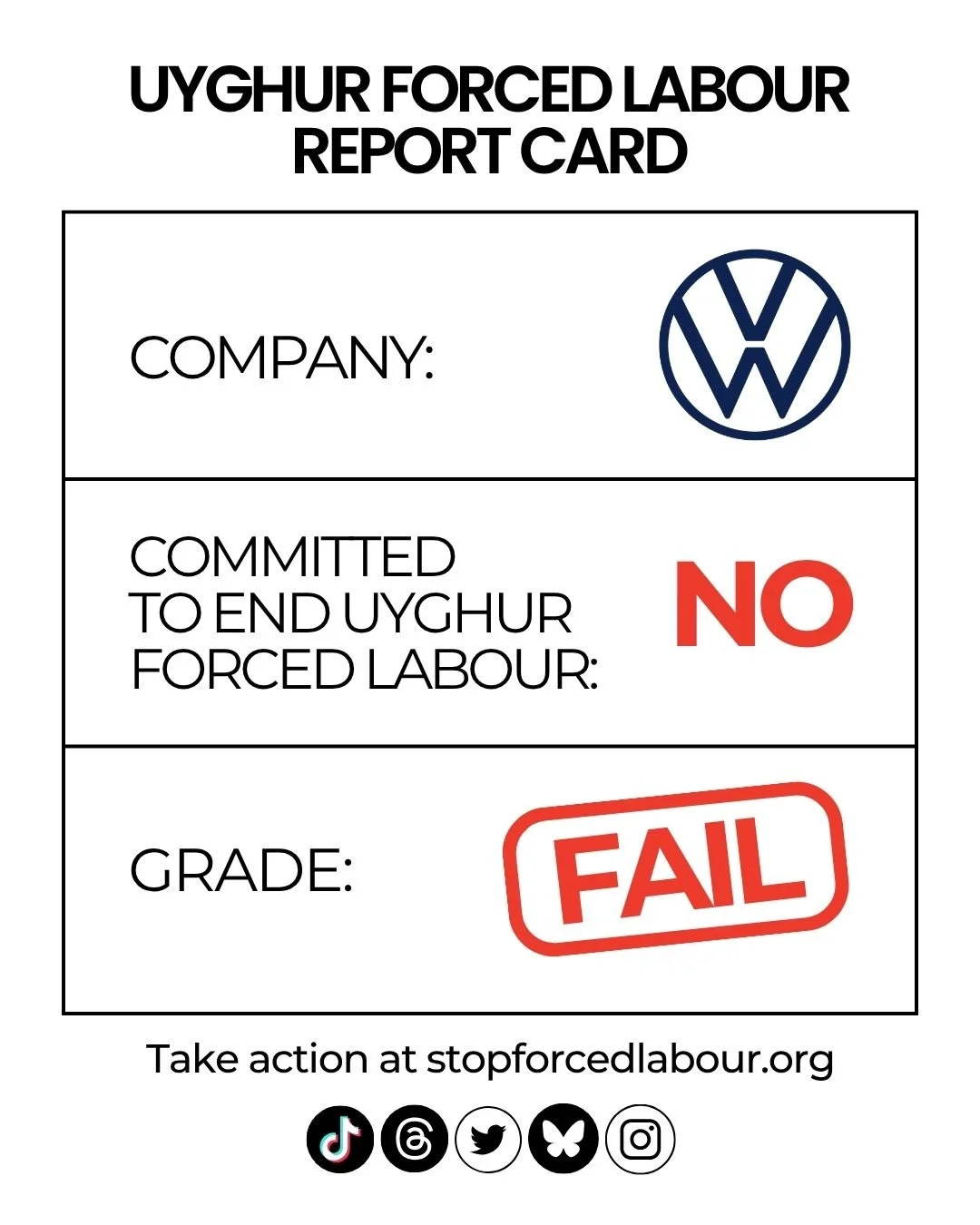
VOLKSWAGEN’S REPORT CARD
Volkswagen has FAILED to make a meaningful commitment to end state-imposed forced labour in the Uyghur Region.
Download the report card.
Share the report card on social media.
EVIDENCE OF FORCED LABOUR RISKS
Multiple investigations have traced Volkswagen’s supply chain and operations to the Uyghur Region:
In 2020, the Australian Strategic Policy Institute identified Volkswagen among global brands whose supply chains were linked to factories using Uyghur workers through labour-transfer programmes.
In 2022, Sheffield Hallam University and Nomogaia found that Volkswagen had the highest number of supply chain links to the Uyghur Region of any automaker assessed. VW had more than 30 links to companies involved in mining, raw-material processing and parts manufacturing in the Uyghur Region, including companies involved in forced labour transfer programmes.
In February 2024, Human Rights Watch reported that Volkswagen’s supply chain remained exposed to aluminium linked to the Uyghur Region.
In January 2024, Volkswagen disclosed that vehicles exported to the US contained a part made by Sichuan Jingweida Technology, a company placed on the UFLPA Entity List over links to Uyghur forced labour. Volkswagen said it replaced the parts before its vehicles entered the U.S.
In 2025, the Bureau of Investigative Journalism, The New York Times and Der Spiegel reported that Volkswagen was among at least 30 car manufacturers whose supply chains were linked to factories receiving workers forcibly transferred from the Uyghur Region
From 2013 to 2024, Volkswagen operated a manufacturing facility in Urumchi, the capital of the Uyghur Region, through its joint venture with Chinese automaker SAIC. Volkswagen also operated a vehicle testing facility in Turpan from 2019.
In November 2024, Volkswagen sold its Urumchi plant and Turpan test track to a Chinese state-owned company, following years of pressure from human rights groups.
ABOUT VOLKSWAGEN
Volkswagen is one of the largest automotive manufacturers in the world (and the largest automaker in Europe). Headquartered in Germany, Volkswagen reported 321.9 billion EUR in sales revenue in 2025 and sold more than 9 million vehicles globally in 2025. Volkswagen is a publicly traded company.
Volkswagen’s global supply chain remains exposed to serious risks of Uyghur forced labour. Researchers have repeatedly identified links between VW’s supply chain and companies tied to forced labour transfer programmes in the Uyghur Region. Uyghur and labour rights groups have been campaigning against VW for years, urging it to eliminate forced labour risks and close operations in the Uyghur Region.
WHAT VW SAYS:
Volkswagen has had a LOT to say publicly. VW has said that:
It found “no further indications that forced labour of Uyghurs is part of the supply chain of the Volkswagen Group China, SAIC Volkswagen and FAW Volkswagen. None of the supplier companies named in the report is currently a direct supplier of Volkswagen. No parts from any of the suppliers named in the report are used in our vehicles. (Reply by Volkswagen AG to ASPI)
Its Urumchi plant did not source from suppliers in the Uyghur Region, and it found no evidence that SAIC-Volkswagen employees were forced to work there or had been held in internment camps. (Statement on visit to “SAIC Volkswagen (Xinjiang) Automotive)
It commissioned an audit of its Urumchi plant that reported “the factory prohibited any employment of forced labour and no forced labour was spotted or found” (VW's audit results; Markus Löning Statement)
It has had “no indications of human rights violations in connection with the test site in Turpan.” (Statement on Turpan Test Center)
SAIC-Volkswagen is a non-controlled joint venture, and its ability to control the joint venture's operations and supply chain is limited. (Volkswagen Group Response to Allegations regarding Business Human Rights)
It does not tolerate any forced labour and has found no evidence of human-rights violations, including violations of ILO standards, in its China operations. (VW's Response to Allegations)
It acknowledged that a component in vehicles had been made by a company on the U.S. government's UFLPA Entity List, saying it notified U.S. authorities after learning of the connection. VW emphasised that it had never stated that “any part of our products contained any part made with forced labour.” (VW's Response to Allegations)
It has “blind spots” in its aluminum supply chain that limit them in identifying risks of exposure to Uyghur forced labour (Human Rights Watch's report)
BUT these answers are not enough.
Volkswagen is STILL at risk of profiting from Uyghur forced labour. VW is still exposed to Uyghur forced labour at all levels of its supply chains and has the MOST documented supply chain links to the region of any other auto company. VW still has over 30 supply chain links to raw materials and manufactured parts in the Uyghur Region, including aluminum, steel, batteries, and electronics.
In summer 2026, our partner, the Uyghur Youth Initiative, reached out to Volkswagen requesting a meeting about its exposure to state-imposed forced labour. Volkswagen DID NOT respond.
VW must now take steps to move its entire supply chain outside the Uyghur Region.
Let’s keep up the pressure on Volkswagen.
WHAT MUST VOLKSWAGEN DO?
We’re demanding Volkswagen:
Trace its entire supply chain back to the raw material level
Stop sourcing raw materials, inputs, and finished products from the Uyghur
Region
End all business relationships with suppliers and companies linked to forced
labour transfers
Shut down all operations – including retail stores – in the Uyghur Region
Disclose how Volkswagen is addressing Uyghur forced labour risks
Forced labour laws already require companies to eliminate and prevent forced labour risks throughout their supply chains – including the US UFLPA, EU FLR, and German Supply Chain Act. Let’s hold Volkswagen accountable.
TAKE ACTION NOW
Are you a shareholder? Use your voice by submitting questions and speaking up during VW’s AGM.
We’ve already been putting pressure on Volkswagen:
2021-2022: The Boston Uyghur Association and Uyghur American Assocition held regular demonstrations in Boston and northern Virginia, calling on Volkswagen to close its plant in the Uyghur Region and address its forced-labour links.
March 2023: We organised a week of action with four petitions, a social media storm, a call-in day, community flyering, a demonstration, and a letter delivered to Volkswagen’s headquarters in Wolfsburg.
May 2023: We organised a week of action around Volkswagen’s Annual General Meeting in Berlin, including a panel, protest, petitions, and shareholder questions on Uyghur forced labour at the AGM.
March 2024: We organised a week of action around Volkswagen’s 2023 annual report, including a social media campaign, petitions, and a video explainer on its social audit.
May 2024: We organised a week of action around Volkswagen’s Annual General Meeting, including a social media campaign, petition delivery in Berlin, and shareholder questions on Uyghur forced labour at the AGM.