APPLE:
STOP UYGHUR FORCED LABOUR
Apple may be selling electronics made with Uyghur forced labour. Demand Apple STOP profiting from exploitation.
Demand X STOP profiting from exploitation
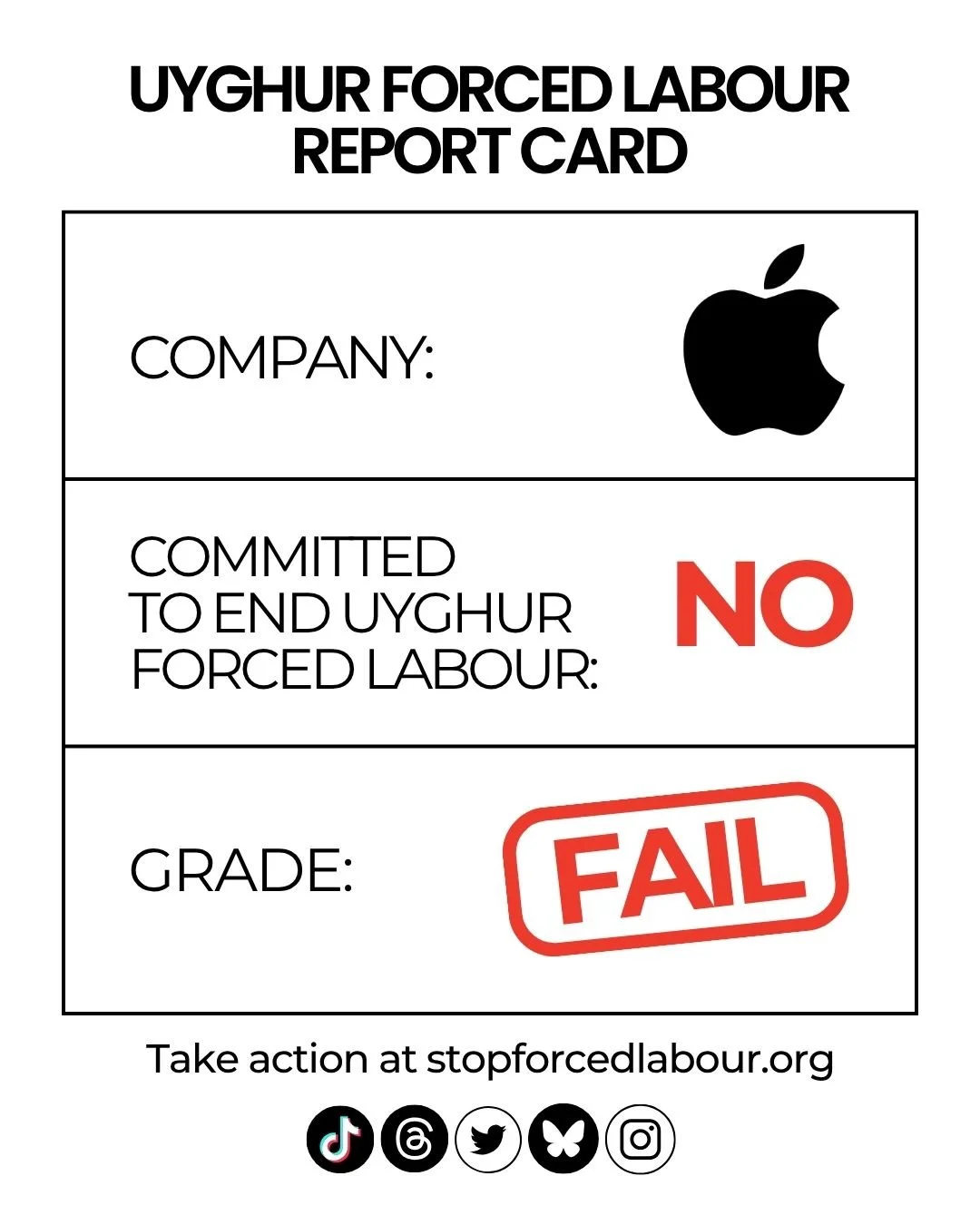
APPLE’S REPORT CARD
Apple has FAILED to prove that its supply chain is free from Uyghur forced labour. Despite evidence linking its supply chain to state-imposed forced labour, Apple has FAILED to make a commitment to eliminate Uyghur forced labour from its supply chain.
Download the report card.
Share the report card on social media.
EVIDENCE OF FORCED LABOUR RISKS
Multiple reports have traced Apple’s supply chain back to the Uyghur Region:
In 2020, the Australian Strategic Policy Institute identified Apple among companies linked to suppliers including O-Film Technology and Foxconn, which were reported to have received hundreds of Uyghur workers under forced labour transfer schemes. O-Film was later added to the UFLPA Entity List, and Apple ended its relationship with the company in 2021.
In 2021, The Information, Tech Transparency Project, and China Labour Watch found seven Apple suppliers that were linked to Uyghur forced labour. At least five were reported to have received thousands of Uyghurs at factories or subsidiaries producing for Apple.
The same year (2021), Tech Transparency Project also linked Apple to Xinjiang Goldwind, one of China’s largest wind turbine manufacturers based in the Uyghur Region, which works with the Chinese government and uses labour transfer programs.
In 2022, Sheffield Hallam University reported that electronics manufactured in the Uyghur Region were connected to suppliers of major global electronics brands, and that multiple Chinese electronic manufacturers have participated in state labour transfer programs.
In 2025, The Bureau of Investigative Journalism, The New York Times and Der Spiegel linked Apple to factories that received workers forcibly transferred from the Uyghur Region.
Apple has authorised partners that sell Apple products in Urumchi, the capital of the Uyghur Region. Apple does not currently operate an Apple Store in the region.
ABOUT APPLE
Apple is one of the largest technology companies in the world. Headquartered in California, Apple made $112 billion in net profit (net income) in 2025 on $416 billion in sales. More than half of its sales – $209.6 billion – came from selling just iPhones. Apple’s services, including apps, iCloud, and music, made another $109 billion, while Mac and iPads made $61 billion. Apple is a publicly traded company.
BUT behind this profit is a global supply chain that remains exposed to serious risks of Uyghur forced labour. Researchers have repeatedly identified links between Apple’s supply chain and companies tied to forced labour transfer programmes in the Uyghur Region.
Workers' rights organisations have documented labour rights abuses throughout Apple’s global supply chain since at least 2010, when grueling working conditions contributed to a series of worker suicides at the massive Foxconn factory complex in Shenzhen, China.
WHAT APPLE SAYS:
Apple said it had “zero tolerance for forced labor” and that “looking for the presence of forced labor is part of every supplier assessment we conduct, including surprise audits.” Apple also said it had “confirmed that none of its suppliers had Uyghur workers from ‘pairing programs’ from Xinjiang working on Apple production lines.”
Apple said it had “found no evidence of any forced labour on Apple production lines” and that it would “continue monitoring.”
Apple said it “supports the goals of the Uyghur Forced Labor Prevention Act,” but at the same time, Apple hired lobbyists to oppose the bill before it became law.
Apple said that, despite the restrictions imposed by COVID-19, it had undertaken further investigations and “found no evidence of forced labor anywhere we operate.”
Apple said it had investigated O-Film and “found no evidence of forced labor on its production lines.” Apple subsequently ended its business relationship with O-Film.
Apple opposed a shareholder proposal requesting a report on the effectiveness of its policies and procedures for protecting workers in its supply chain from forced labour, including forced labour linked to the Uyghur Region. Apple has since revised its human rights policy, but has not disclosed the steps it will take to eliminate exposure to Uyghur forced labour as requested in the shareholder proposal.
Recent audits of its suppliers found “no instances of forced labour,” and it is investigating the alleged link to forced labour
During a visit to Beijing and Shanghai in March 2026, Apple’s CEO (now Chairman) Tim Cook said, “China is so important to us. It remains the most important part of our supply chain.”
In summer 2026, our partner, Freedom United, reached out to Apple requesting a meeting about its exposure to state-imposed forced labour and to understand what steps Apple is taking to address these risks. Apple responded with a generic email pointing to its policies BUT failed to answer our questions about Uyghur forced labour.
Apple must do better. Apple must provide answers - and take action!
WHAT MUST X DO?
Apple must stop profiting from Uyghur forced labour.
We’re demanding Apple:
Trace its entire supply chain back to the raw material level
Stop sourcing raw materials, inputs, and finished products from the Uyghur Region
End all business relationships with suppliers and companies linked to forced labour transfers
Shut down all operations – including retail stores – in the Uyghur Region
Disclose how Apple is addressing Uyghur forced labour risks
Forced labour laws already require companies to eliminate and prevent forced labour risks throughout their supply chains – including the US UFLPA, EU FLR, and German Supply Chain Act. Let’s hold Apple accountable.
TAKE ACTION NOW
We’ve already been putting pressure on Apple:
2020-2021: Apple shareholders filed a resolution on behalf of Eko (formerly SumOfUs) calling on Apple to strengthen policies against forced labour. Uyghur, Tibetan, Hong Kong, and other allies campaigned against Apple through social media, petitions, and protests in Washington, D.C., and Virginia. In August 2020, Apple adopted its first human rights policy. Watch the campaign video.
2022: Eko (formerly SumOfUs) coordinated another shareholder resolution calling on Apple to report how it identifies and addresses forced-labour risks in its supply chain, including Uyghur forced labour. Uyghurs and allies continued pressure through social media and protests in Washington, D.C. Apple voted against the proposal.
2023-2024: Uyghur groups and allies organised protests at Apple stores across the U.K. calling for an end to Uyghur forced labour in Apple’s supply chain.